Gratuity Rules for Government Employees: Eligibility, Formula & Calculation Explained
In this Article
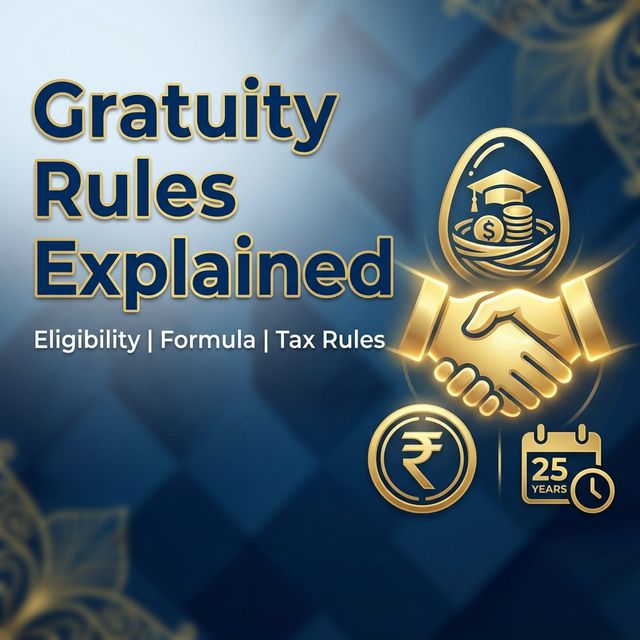
Gratuity is a monetary benefit given by an employer to an employee at the time of their retirement, resignation, or death. It is a token of appreciation for the long and continuous service rendered by the employee.
For Central and State Government employees, gratuity is a significant component of their retirement corpus. However, many employees are often confused about the eligibility criteria, the exact calculation formula, and the maximum limits applicable.
In this guide, we will simplify the Gratuity Rules for Government Employees and show you how to estimate your entitlement.
1. Introduction
Gratuity acts as a financial reward for loyalty and service. Unlike a monthly pension, it is a one-time lump sum payment.
For government employees, gratuity is governed by the Central Civil Services (Pension) Rules and is distinct from the Payment of Gratuity Act, 1972 (which primarily covers private sector employees).
Understanding these rules ensures you know exactly what to expect when you hang up your boots.
2. What Is Gratuity for Government Employees?
Retirement Gratuity is the lump sum amount paid to a government servant who retires from service.
- Applicability: It applies to all Central Government employees (including those under OPS and NPS*).
- Safety Net: Along with pension and leave encashment, gratuity forms the third pillar of retirement security.
(Note: NPS employees are also eligible for Retirement Gratuity on the same terms as OPS employees).
3. Eligibility Criteria for Gratuity
To be eligible for gratuity, specific conditions must be met:
- Minimum Service: An employee must complete at least 5 years of qualifying service to be eligible for Retirement Gratuity.
- Service Condition: The service must be continuous without any break due to disciplinary action.
- Exceptions:
- Death Gratuity: If an employee dies while in service, the 5-year rule is waived. The family is eligible for gratuity based on the length of service (even less than 1 year).
- Disablement: If an employee retires due to disability, the eligibility criteria are relaxed.
4. Gratuity Calculation Formula Explained
The formula for calculating Retirement Gratuity for government employees is straightforward.
It depends on two factors:
- Last Drawn Emoluments: (Basic Pay + Dearness Allowance)
- Qualifying Service: Every completed 6-monthly period counts as one unit.
The Formula:
Gratuity = (1/4) × (Last Basic Pay + DA) × (Number of Completed 6-Monthly Periods)
Alternatively, it is often simplified as:
Gratuity = 15 Days’ Salary × Number of Completed Years of Service
(Note: For government calculation, “15 days” is mathematically derived as half a month’s emolument for every completed year).
5. Gratuity Calculation Example
Let’s look at a practical example to understand this better.
Scenario:
- Employee Name: Mr. Verma
- Date of Retirement: 31st March 2024
- Total Service: 30 Years
- Last Basic Pay: ₹60,000
- DA Rate on Retirement: 50%
Step 1: Calculate Last Emoluments
- Basic Pay: ₹60,000
- DA (50%): ₹30,000
- Total Emoluments: ₹90,000
Step 2: Apply the Formula
- Gratuity = (Total Emoluments) × (1/2) × (Years of Service)
- Gratuity = ₹90,000 × 0.5 × 30
- Total Gratuity Payable = ₹13,50,000
6. Maximum Gratuity Limit for Government Employees
There is a ceiling on the maximum amount of gratuity that can be paid.
- Current Limit: ₹20 Lakhs.
- Future Revision: As per the 7th Pay Commission recommendations, the gratuity ceiling is to be increased by 25% whenever the DA rises by 50%.
- Since DA touched 50% in Jan 2024, the government officially announced the enhancement of the gratuity limit to ₹25 Lakhs.
7. When Gratuity Is Reduced or Not Paid
Gratuity is not an absolute right; it can be withheld or forfeited in certain cases:
- Disciplinary Proceedings: If departmental or judicial proceedings are pending against an employee at the time of retirement, gratuity can be withheld until the conclusion of the case.
- Government Dues: If you owe any dues to the government (e.g., license fee for quarters, overpayment of salary), these can be recovered from your gratuity.
- Dismissal: If an employee is dismissed from service for misconduct, gratuity may be forfeited fully or partially.
8. Taxability of Gratuity for Government Employees
One of the biggest benefits for government employees is the tax treatment of gratuity.
- Tax Exempt: The entire amount of Death-cum-Retirement Gratuity received by Central & State Government employees is fully exempt from income tax under Section 10(10)(i) of the Income Tax Act.
- No Limit: Unlike private sector employees (who have a tax-free limit), the entire gratuity for govt employees is tax-free.
9. How to Calculate Gratuity Online
Calculating qualifying service in 6-monthly periods and applying correct DA rates can be tricky manually.
👉 Use our Gratuity Calculator to estimate your gratuity amount instantly
You can also plan your complete retirement corpus by checking our NPS Pension Calculator.
10. FAQs (Frequently Asked Questions)
Who is eligible for gratuity in government service?
Any permanent government employee who retires after completing a minimum of 5 years of qualifying service is eligible. In case of death, there is no minimum service requirement.
How is gratuity calculated for govt employees?
It is calculated as: (Last Basic Pay + DA) × 1/4 × Number of completed 6-monthly service periods. Roughly, it equals half a month’s salary for every year of service.
What is the maximum gratuity amount?
The current maximum ceiling is ₹25 Lakhs (enhanced from ₹20 Lakhs after DA crossed 50%).
Is gratuity taxable for government employees?
No, gratuity received by government employees is completely tax-free under the Income Tax Act.
When is gratuity paid after retirement?
It is usually paid within a month of retirement, provided all “No Due Certificates” and pension papers are processed in time.
Disclaimer: The rules mentioned are based on CCS (Pension) Rules and latest office memorandums. Government policies are subject to change. Please consult your pension sanctioning authority for official confirmation.
Planning for retirement? Ensure you get every rupee you deserve. Use our Gratuity Calculator to check your dues and our NPS Explained Guide to maximize your pension.