Salary Structure for Central Government Employees Explained (Basic Pay, DA, HRA & Allowances)
In this Article
Understanding the salary structure for Central Government employees can be confusing due to the various components like Basic Pay, Grade Pay (now Levels), DA, HRA, and numerous other allowances. Whether you are a newly joined employee or an aspirant, knowing how your salary is calculated is essential for financial planning.
In this guide, we will break down every component of the salary slip, from earnings to deductions, and explain how they contribute to your final in-hand salary.
1. Introduction
The salary of Central Government employees is governed by the recommendations of the Pay Commission, currently the 7th Pay Commission. The structure is designed to be comprehensive, covering the cost of living (via DA), housing (via HRA), and other specific needs.
Understanding this structure helps you verify your payslip, calculate arrears correctly, and plan for future increments and promotions.
2. What Is Salary Structure in Central Government?
The salary structure is broadly divided into two parts:
- Gross Salary: The total earnings before any deductions.
- Net Salary (In-Hand): The amount credited to your bank account after deductions.
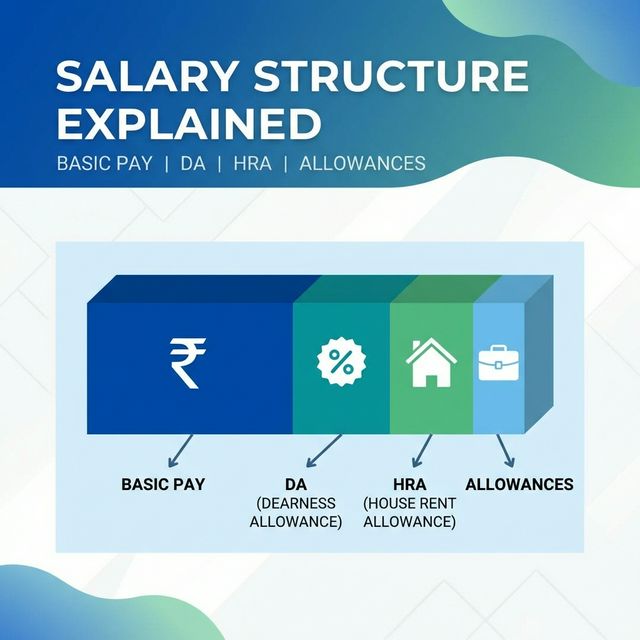
Gross Salary = Basic Pay + DA + HRA + Transport Allowance + Other Allowances
Net Salary = Gross Salary - (NPS + Income Tax + Professional Tax + Other Deductions)
3. Basic Pay Explained
Basic Pay is the core component of your salary. It is the fixed amount paid to an employee based on their designation and level in the Pay Matrix.
- 7th Pay Commission: Introduced the Pay Matrix system, replacing the earlier Pay Band and Grade Pay system.
- Significance: Most allowances (like DA and HRA) are calculated as a percentage of your Basic Pay. Even your pension is based on your last drawn Basic Pay.
- Annual Increment: Basic Pay typically increases by 3% every year (usually in January or July).
4. Dearness Allowance (DA)
Dearness Allowance (DA) is a cost-of-living adjustment allowance paid to government employees and pensioners.
- Purpose: To mitigate the impact of inflation. As prices of goods and services rise, DA is increased to maintain your purchasing power.
- Revision: DA is revised twice a year, effective from January 1st and July 1st.
- Calculation: It is a percentage of your Basic Pay. For example, if your Basic Pay is ₹30,000 and the DA rate is 50%, your DA amount will be ₹15,000.
5. House Rent Allowance (HRA)
House Rent Allowance (HRA) is paid to employees to meet their accommodation expenses. The amount depends on the city where you are posted.
Cities are classified into X, Y, and Z categories based on population:
| City Category | Current HRA Rate | Examples |
|---|---|---|
| X (Tier 1) | 30% of Basic Pay | Delhi, Mumbai, Chennai, Kolkata, Bangalore, Hyderabad, etc. |
| Y (Tier 2) | 20% of Basic Pay | Pune, Jaipur, Lucknow, Patna, etc. |
| Z (Tier 3) | 10% of Basic Pay | All other cities and towns. |
Note: HRA rates were revised to 30%, 20%, and 10% when DA crossed 50%.
6. Other Allowances for Central Government Employees
Besides the main components, employees receive various other allowances:
- Transport Allowance (TA): To cover commuting expenses between home and office. The rate depends on the pay level and city category.
- DA on TA: Dearness Allowance is also payable on the Transport Allowance.
- Transfer Grant: Paid when an employee is transferred from one station to another.
- Special Allowances: Depending on the department (e.g., Risk Allowance, Non-Practice Allowance for doctors).
7. Deductions from Salary
Your distinct take-home salary is arrived at after specific deductions:
- NPS (National Pension System): Mandatory contribution of 10% of (Basic Pay + DA). The government contributes 14%.
- CGEGIS: A small insurance scheme contribution.
- CGHS: Deduction for health updates/facilities.
- Income Tax (TDS): Tax Deducted at Source based on your estimated annual income and tax regime.
- Professional Tax: Levied by some state governments.
8. Example: Central Government Employee Salary Breakdown
Let’s look at a realistic example of a Level 6 employee posted in a Class Y city.
- Pay Level: Level 6
- Basic Pay: ₹35,400
- DA Rate: 50%
- HRA Rate: 20% (Y City)
- TA: ₹3,600 (Assumed for Level 6)
Earnings:
- Basic Pay: ₹35,400
- DA (50%): ₹17,700
- HRA (20%): ₹7,080
- Transport Allowance: ₹3,600
- DA on TA (50%): ₹1,800
- Total Gross Salary: ₹65,580
Deductions:
- NPS (10% of Basic+DA): ₹5,310
- CGHS/Include: ~₹650 (Approx)
- Total Deductions: ₹5,960
In-Hand Salary: ₹65,580 - ₹5,960 = ₹59,620
9. How to Calculate In-Hand Salary
Calculating this manually every time DA changes can be tedious.
👉 Use our 8th Pay Salary Calculator to calculate your revised salary easily
You can also check your HRA eligibility specifically with our HRA Calculator.
10. FAQs (Frequently Asked Questions)
What is basic pay in central government salary?
Basic Pay is the standard rate of pay assigned to a government servant in the Pay Matrix. It does not include any allowances or special pay.
How is DA calculated?
DA is calculated as a specific percentage of the Basic Pay. The percentage is revised semi-annually based on the AICPI (Consumer Price Index).
Who is eligible for HRA?
All employees who do not avail of government accommodation are eligible for HRA. If you live in government quarters, you do not get HRA.
What is the difference between gross and net salary?
Gross salary is the total earnings inclusive of all allowances. Net salary (in-hand) is the final amount remaining after deducting NPS, taxes, and other contributions from the gross salary.
Disclaimer: This article is for informational purposes only. Salary rules, rates, and allowances are subject to change as per official government notifications. Please verify with your department’s accounts section.
Want to check your exact dues? Use our DA Arrears Calculator to see if you have any pending payments!