Key Takeaways
- Form 12BB is replaced by Form 124 starting from Financial Year 2026-27 under the new Income Tax framework.
- Form 124 requires stricter disclosures, including the relationship with the landlord for HRA claims.
- Submitting these forms accurately ensures correct monthly TDS and higher in-hand salary.
- Failure to submit proofs later in the year will result in higher TDS deduction in the final quarter.
- The New Tax Regime is the default, but you still need these forms to declare specific exempt components if opting for the Old Regime.
If you are a salaried employee in India, you’ve likely seen your HR department asking for “Tax Declarations” every April or May. This process is governed by two critical documents: Form 12BB (the traditional standard) and Form 124 (the new 2026 framework).
Understanding these forms is the difference between having a healthy monthly take-home salary and seeing a massive chunk of your hard-earned money vanish as TDS (Tax Deducted at Source).
In this comprehensive 2500+ word guide, we will break down the transition, the new disclosure requirements, and how you can maximize your tax savings while staying compliant with the 2026 Income Tax Act and 2026 Rules.
2026 Compliance Update
Quick Declaration Reference
Applicable Form
Form 124
For FY 2026-27 onwards
HRA Deadline
Monthly
Declaration at start
Key Disclosure
Relationship
Relative claims
🏛️ Chapter 1: The Transition — Form 12BB vs. Form 124
For decades, Form 12BB was the only document salaried employees needed to worry about. However, as part of the digital transformation of the Income Tax Department and the introduction of the Taxation Laws (Amendment) Act, 2026, a more robust framework was needed.
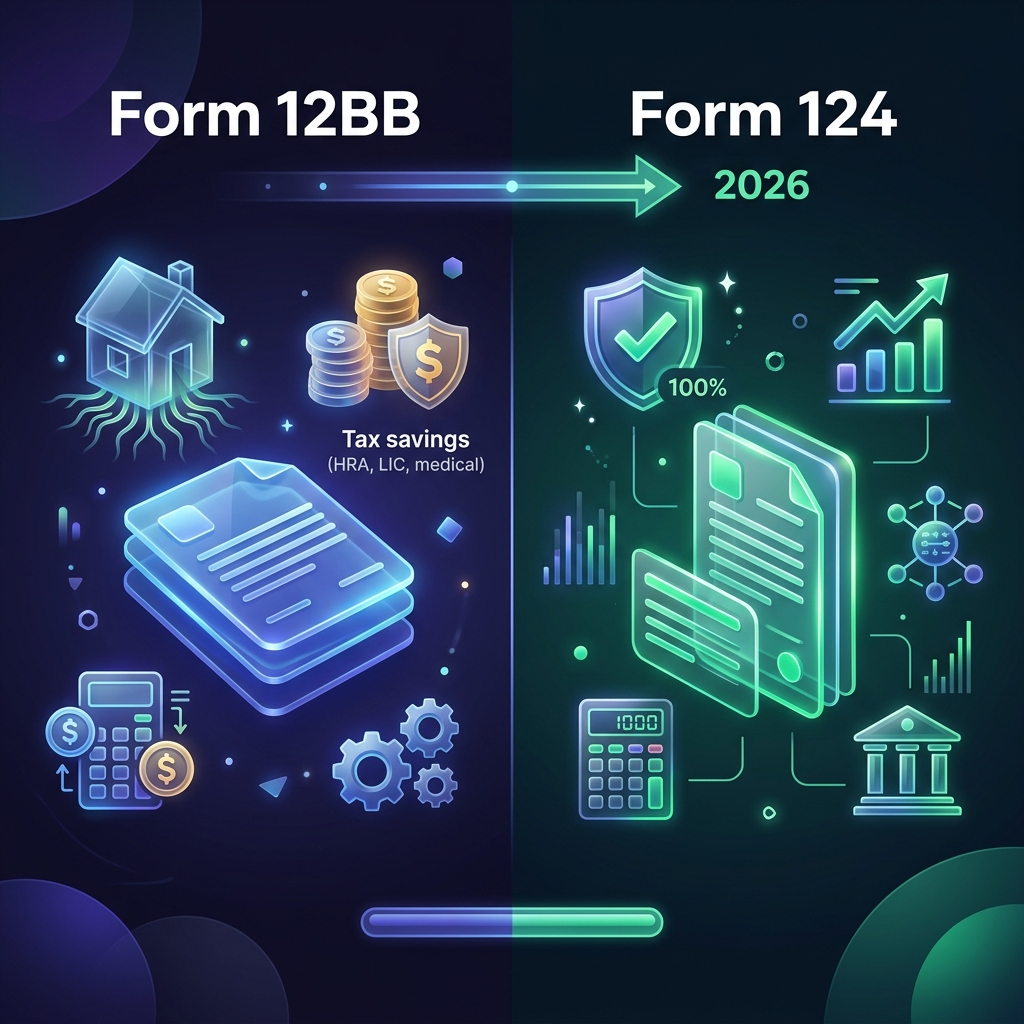
Visual Summary: Key legislative and disclosure changes in the 2026 Tax Framework.
Why the change?
The primary goal of the transition to Form 124 is to increase transparency and reduce “synthetic” claims. In the past, many employees made verbal or basic declarations that were hard for the department to verify at scale. Form 124 introduces structured data points that link directly to the employer’s quarterly TDS returns (Form 24Q).
Comparison: The Premium Card Table
🧠 Chapter 2: What is Form 12BB / Form 124? (The Definition)
Both forms serve as a declaration document submitted by an employee to their employer at the beginning and middle of the financial year.
The Purpose:
Your employer is legally obligated to deduct TDS from your salary every month. However, they don’t know your life situation—whether you live in a rented house, have a home loan, or invested in a tax-saving mutual fund (ELSS).
By submitting Form 12BB or Form 124, you are essentially saying:
“Hey, my gross salary is ₹15 Lakhs, but I am spending ₹3 Lakhs on HRA and saving ₹1.5 Lakhs in PPF. Please calculate my tax on ₹10.5 Lakhs, not ₹15 Lakhs.”
The Direct Impact:
- Correct TDS: Lower tax deduction every month.
- Higher Cash Flow: More “In-Hand” salary to spend or invest.
- Refund Avoidance: You don’t have to wait 12 months for the government to refund your excess tax.
👨👩👧👦 Chapter 3: Section-Wise Guide to Declarations
Let’s break down the key components you will encounter while filling out these forms.
1. House Rent Allowance (HRA)
This is often the largest tax-saving component for salaried individuals. To claim HRA exemption under Section 10(13A):
- You must be living in a rented accommodation.
- The rent must be actually paid.
- Landlord PAN: Mandatory if total annual rent exceeds ₹1,00,000.
[!WARNING] The Form 124 “Relationship” Rule: In the 2026 framework, you must explicitly state if the landlord is a parent, spouse, or relative. If you claim HRA for staying with parents, ensure you actually transfer money and your parents report it as rental income in their ITR.
2. Leave Travel Allowance (LTA)
LTA allows you to claim tax exemption on domestic travel for yourself and your family.
- Exemption is only on the ticket cost (Air, Rail, or Bus).
- Food and hotel expenses are taxable.
- You must provide boarding passes and tickets later in the year.
3. Section 80C Deductions (Max ₹1.5 Lakh)
This is the “basket” of investments. Common items to declare:
- EPF: Your contribution to Employee Provident Fund.
- PPF: Public Provident Fund deposits.
- ELSS: Tax-saving mutual funds.
- Life Insurance Premium: For self, spouse, or children.
- Tuition Fees: Paid for up to two children.
- Home Loan Principal: The principal portion of your EMI.
4. Section 80D (Health Insurance)
- Self/Family: Up to ₹25,000.
- Parents (<60 years): Additional ₹25,000.
- Parents (>60 years): Additional ₹50,000.
- Preventive Health Checkup: Up to ₹5,000 (included in the above limits).
🛡️ Chapter 4: Major Changes in Form 124 (The 2026 Shift)
Form 124 is not just a renamed version of 12BB. It introduces several “Safe Harbor” and “Compliance” checkpoints.
1. Landlord Relationship Disclosure
As mentioned, the department has noticed a high volume of HRA claims where the landlord’s PAN is of a relative. Form 124 requires you to disclose this relationship. This doesn’t make the claim illegal, but it increases the scrutiny on whether the transaction was genuine.
2. Stricter Documentation Requirements
While you only submit a “declaration” in April, Form 124 explicitly mentions that the employer must hold the responsibility of verifying the “reasonableness” of the claim. This means HR departments in 2026 will be more likely to reject claims if the rent agreement looks suspicious or PANs don’t match.
3. Linkage with AIS (Annual Information Statement)
The new forms are designed to be cross-referenced with your AIS. If you declare a home loan interest in Form 124, but your bank hasn’t reported that interest in your AIS, the Income Tax portal might flag a mismatch during ITR filing.
📝 Chapter 5: Documents Required Checklist
To ensure your Form 12BB/124 is accepted, keep these ready:
🏠 For HRA Claims
- ✅ Rent Receipts (Signed)
- ✅ Rental Agreement
- ✅ Landlord’s PAN Card Copy
- ✅ Bank Transfer Proof (Recommended)
💰 For 80C & 80D
- ✅ LIC Premium Receipts
- ✅ ELSS Statement
- ✅ PPF Passbook Copy
- ✅ Health Insurance Certificate
🛑 Chapter 6: Common Mistakes to Avoid
1. Not Submitting the Form on Time
Most employers have a “cutoff date” (usually May 31st). If you miss this, they will calculate TDS on the full salary for the months of April, May, and June. Even if you submit later, the “Excess TDS” already deducted won’t be returned by the employer—you’ll have to wait for your ITR refund.
2. Fake Rent Claims
The Income Tax Department now uses AI to cross-check landlord PANs. If your landlord doesn’t report the rent you’ve declared, both you and the landlord could face notices and penalties of up to 200% of the tax evaded.
3. Missing Landlord PAN
If your rent is ₹8,400 per month or more, you MUST provide the landlord’s PAN. Without it, the employer is legally bound to reject the HRA exemption and apply TDS on the HRA component.
4. Wrong Financial Year Selection
Ensure you are using the correct form for the correct year. For the current transition year, using 12BB for 2026 periods might lead to administrative rejection by your payroll portal.
🔄 Chapter 7: Step-by-Step Guide to Filling Form 124
Step 1: Employee Details
Fill in your Name, Address, PAN, and Employee Code. Ensure the PAN is correct; any typo here will make the entire form invalid in the eyes of the TRACES portal.
Step 2: Rent Details
Enter the monthly rent amount and the total rent for the year. Mention the Landlord’s name, PAN, and Address. New in 2026: Check the box for ‘Relationship with Landlord’ and specify (e.g., Parent, None).
Step 3: LTA Details
If you traveled or plan to travel, enter the estimated amount. Remember, you can claim this twice in a block of 4 years.
Step 4: Interest on Housing Loan
Enter the Lender’s name (Bank/HFC), their PAN, and the interest amount. Mention the address of the property. Ensure you are the owner or co-owner of the property.
Step 5: Chapter VI-A Deductions
List your investments under 80C, 80D, 80G (Donations), and 80E (Education Loan Interest).
Step 6: Verification
Sign and date the form. By signing, you are declaring that all information provided is true and that you possess the necessary proofs.
🧮 Chapter 8: Advanced Calculation Examples
Let’s look at how Form 124 affects your bank balance.
The Declaree
Form 124 Submitted
The Non-Declaree
Missed Deadline
The Refund Seeker
Claims in ITR
🏛️ Chapter 9: Legal Nuances & Employer Responsibilities
Section 192 vs. Rule 205
Under Section 192, the person responsible for paying salary must deduct tax. Rule 205 (associated with Form 124) prescribes the specific data points that must be collected.
The Employer’s Burden
The employer is not just a collection point. If they accept a declaration that is blatantly false (e.g., claiming HRA for a non-existent property), the department can hold the employer as an “Assessee in Default”. This is why your HR department might seem “difficult” when asking for rent agreements—they are protecting the company from legal liability.
Digital Verification in 2026
With the 2026 framework, many large employers are moving away from PDF forms to digital portals. These portals are often linked with NSDL and UIDAI to verify PAN and Aadhaar in real-time.
🏁 Conclusion: Your Roadmap to a Stress-Free Tax Season
Form 12BB and Form 124 are the gatekeepers of your take-home pay. By spending 30 minutes in April to fill them out correctly, you ensure that you aren’t providing the government with an interest-free loan for 12 months.
Key Action Steps:
- Collect PANs: Get your landlord’s PAN and your home loan interest certificate now.
- Estimate Realistically: Don’t over-declare in April only to have a massive TDS hit in March when you can’t provide proofs.
- Check AIS: Ensure your investments are reflecting in your Annual Information Statement.
- Use Tools: Use our In-Hand Salary Calculator to see the exact difference between Old and New Regimes before you choose in Form 124.
🔥 High-Value Resource
The 8th Pay Implementation Handbook
The rules for 2026 are shifting. Don’t let your tax declaration be a guessing game—take control with our expert roadmap.
🔗 Internal Links (Explore More)
- Section 80C Guide — Maximize your ₹1.5 Lakh limit.
- HRA Calculator — Calculate your exact exemption.
- Income Tax Calculator — Estimate your liability before Form 16 arrives.
- In-Hand Salary Calculator — Compare Old vs New Tax Regimes.
- Salary After Tax Guide — Understanding your real take-home.
- Form 16 Guide — The certificate that follows your declaration.
FAQs
Is Form 124 mandatory for everyone?
Yes, if you are a salaried employee and want your employer to consider any tax-saving investments or HRA for TDS calculation, you must submit Form 124 (or 12BB for older years).
What happens if I don't submit Form 124?
Your employer will not consider any deductions or HRA exemptions. They will deduct TDS based on your gross salary, leading to a significantly lower take-home pay.
Do I need to submit physical proofs with Form 124?
Usually, only a 'declaration' is needed at the start of the year. However, actual proofs (rent receipts, investment certificates) must be submitted to the employer by January or February.
Can I claim HRA if my landlord is my parent?
Yes, but it must be a genuine transaction. Form 124 now specifically requires you to disclose if the landlord is a relative.
Related Resources
Related Guides
-
Form 10E: Complete Guide to File & Calculate Tax Relief (AY 2025-26)
Learn how to fill Form 10E online, calculate Section 89(1) tax relief, download the form, and avoid IT notices. Updated for AY 2025-26 with step-by-step guide.
-
Form 16: The Ultimate 2026 Guide for Salaried Employees in India
Master Form 16 (Part A & B). Learn how to download, understand the password format, read salary details, handle multiple employers, and file ITR like a pro in 2026.
-
Leave Travel Allowance (LTA) 2026: Rules, Exemption, Block Years & Examples
Master LTA rules under Section 10(5). Learn about block years (2022-25), carry forward rules, family definition, tax exemption calculation, and 8th Pay Commission projections.
-
Form 10BA: Complete Guide to Section 80GG Rent Deduction (2026)
Comprehensive guide on Form 10BA and Section 80GG. Learn how to claim rent deduction without HRA, eligibility rules, calculation steps, and online filing. Updated for AY 2026-27.